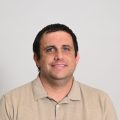
Millions of Americans were watching Katie Couric and Matt Lauer on the “Today” show on Sept. 11, 2001. Amherst firefighter-paramedic Joshua Shanley was one of them.
He had just finished an overnight shift and was having breakfast and coffee in the Connecticut apartment of his then-girlfriend (now his wife) when he saw that an airliner had flown into the World Trade Center. At first he thought it might have been a freak accident. Then, a second plane struck the South Tower.
“At that point, things shifted,” Shanley recalled, adding that he packed up his gear and drove back to his Amherst Fire station. “I really didn’t know what else to do at that point. It just felt like the place to be.”
Shanley was a K-9 handler with a Massachusetts Urban Search & Rescue Team, but his dog was not yet certified, so he missed the initial deployment to assist at Ground Zero. He wound up going with the Western Mass Critical Incident Stress Management team five days after the attacks and stayed for five days.
Shanley helped sift through the rubble looking for first responders and civilians, and remembers whenever the remains of a police officer or firefighter were found. He explained that someone would blow a whistle and there would be a moment of silence before the remains were removed.
“It was a kind of improvised … dignified transfer,” he recounted. “And then everyone was right back at it.”


Shanley and his partner, Bill Dunn, who has since retired, were put up in a hotel overlooking Times Square.
“It was just eerie being in New York City at that time,” Shanley said. “Everything was empty.”
Shanley was very familiar with the city, having grown up in Brooklyn and Greenwich Village, and was tasked with driving around to pick up supplies, food and water.
New York City recently released at least 170,000 pages of previously undisclosed records showing that officials knew the air around Ground Zero was unsafe after the attacks, despite telling the public and rescue workers that it was safe. According to online sources, 453 FDNY members have died from World Trade Center-related illnesses, surpassing the 343 firefighters who died on 9/11, and an FDNY World Trade Center Health Program report found that at least 12,000 department members have been diagnosed with at least one illness linked to their exposure at Ground Zero.
Shanley, who later worked for the Northampton Fire Department and now lives in Connecticut, said he has not had health issues stemming from his work that day, though some people he is close with have not been so lucky.
The 9/11 attacks killed 2,977 people. American Airlines Flight 77 was hijacked and flown into the west side of the Pentagon, and United Airlines Flight 93 crashed near Shanksville, Pennsylvania, when the hijackers deliberately sent the plane into a nosedive after passengers and crew attempted to retake control of the cockpit.
An improbable coincidence
Shelburne resident Fred DeVecca lost two people on 9/11. But they weren’t just his friends; they were his Morris dance teammates.
Stephen Adams, 51, had joined the Marlboro Morris Men shortly after its formation in the mid-1980s. He worked at the Windows on the World, an upscale restaurant on the North Tower’s 106th and 107th floors, and had just been promoted to beverage manager. Christoffer “Chris” Carstanjen, 33, joined the team in the mid- to late-1990s and was a computer research specialist for the Office of Information Technologies at the University of Massachusetts Amherst. He was on the hijacked United Airlines Flight 175 that crashed into the South Tower.
“When you’re on a Morris team, there’s a really solid bond,” DeVecca said. “You’re all really close friends, and there’s a really strong connection.”

Morris is a traditional English folk dance based on rhythmic stepping and choreographed figures performed by groups of dancers known as “sides.” It involves sticks, swords, handkerchiefs and has a musical accompaniment.
DeVecca described Adams as his best friend and a bit of an aimless drifter for much of his life. He majored in philosophy in college and struggled to find work. He eventually attended the French Culinary Institute to become a chef and made his way into the beverage management aspect of the restaurant industry. He moved to New York earlier in 2001 and started working at Windows on the World.
“He was very excited about it,” DeVecca recalled. “Things were looking up, and he was very excited.”
He mentioned that he was eventually shown Adams’ wallet, which was recovered from Ground Zero.
“It had a shard of glass through it; other than that, it was intact,” he said.
DeVecca described Carstanjen as a motorcycle enthusiast. He was on a flight to California for the annual Great Pacific Coast Motorcycle Ride. According to the Voices Center for Resilience (formerly known as Voices of September 11th) — a nonprofit organization that provides long-term mental health support, resources and advocacy for victims’ families — he was known as “Captain Tupperware” due to his red Honda Pacific Coast 800, which bore a “Body by Tupperware” decal.
DeVecca said he and his other Morris dance teammates knew Windows on the World had been struck in the Manhattan attacks, so they had resigned themselves to the fact that Adams was very likely dead. However, they didn’t learn that Carstanjen was on one of the airliners until a teammate who also worked at UMass forwarded an email announcing his death.
“And we were not prepared for that. That was like a gut punch,” DeVecc said. “It was like the whole world collapsed then, at that point.”
He mentioned that the Marlboro Morris Men got together in Amherst a day or two after the attacks to dance in the streets in their friends’ memory. Two spots were left empty for Adams and Carstanjen.
“It was a brutal night to be out dancing,” DeVecca said.
In September 2001, he worked for Memorial Hall Theater in Shelburne and had stopped by that fateful morning to meet with a man doing minor maintenance work there. He said the man immediately asked if the nation was at war. DeVecca had no clue what he was talking about and drove home to watch the news.
“And then I found out what was going on,” he recalled. “I watched it all day long, and for days afterward.”
‘I think about it every day’
September 11th Families for Peaceful Tomorrows was born when a small group of people whose family members were killed on 9/11 became connected after reading each other’s pleas for nonviolent responses to the terrorist attacks.
The website was launched on Valentine’s Day in 2002 to add a message of compassion and peace to the political landscape and try to convince then-President George W. Bush to support the creation of an Afghan victims’ fund to assist innocent civilians affected by the U.S.-led war in Afghanistan. Robyn Donati, who now lives in Bernardston, joined within the following year, as she was determined to not allow her mother’s death to be used to justify war and destruction.

“Because, you know, it’s not going to bring our family members back,” she told the Greenfield Recorder.
Roberta Bernstein Heber, 60, was an assistant vice president and a systems analyst at Marsh & McLennan, a professional services firm, in the World Trade Center’s North Tower and was at work when the hijacked American Airlines Flight 11 slammed into the building. She was survived by her husband, Jack, and her children, Robyn, Stuart, and Melissa, and grandchildren Aurora, Alex, Jason and Jenna. She was awaiting the arrival of her newest granddaughter, who was born on Sept. 19.
That fateful morning, Donati was home in Bolton getting ready to go to work at a residential treatment school for girls with mental health issues when she saw on the news that a plane had struck the World Trade Center. She immediately tried to call her mother, to no avail, “and it went downhill from there.”
Donati said it was roughly three weeks before she was told to consider her mother deceased, though it took months before it became official.
“I think about it every day,” she said.
Peaceful Tomorrows was launched as a project of the Fellowship of Reconciliation — USA. In January 2002, four family members of 9/11 victims visited Afghanistan to see for themselves the consequences of American military action following the attacks and to express their concern that high numbers of civilian casualties would increase terrorist recruitment, rather than making the United States or the world safer.
Donati said the group offers fellowship to victims of all forms of terrorism and fights for all suspects of terrorism to receive free, fair and unbiased trials. She said she sits on the board and also co-chairs the group’s Islamophobia Committee, which works to support Muslims subjected to violence, hate crimes, prejudice and racism.
“It’s important to me to try to make the world different,” Donati said.
She also said her advocacy helps preserve her mother’s memory and legacy.
After graduating from college and working as a high school math teacher, Heber chose to stay home and raise her children. As they grew up, she went back to school and earned a master’s degree in computer science, eventually returning to the workforce. She lived in Manhattan at the time of her death.
More information about Peaceful Tomorrows is available at: www.peacefultomorrows.org/.